jueves, 1 de febrero de 2018

THE BABINGTON PLOT (1586)

LOCATION: England

PERPETRATORS: Anthony Babington and Mary, Queen of Scots; Sir Francis Walsingham

MOTIVATION: Treason and espionage

BACKGROUND: The beginning of the Protestant Reformation is conventionally dated to the moment in 1517 when Martin Luther nailed a list of criticisms of the Catholic Church to the door of a church in the city of Wittenberg, Saxony.

In England, King Henry VIII split from Rome for political and personal reasons rather than religious ones. He wanted to annul his marriage to Catherine of Aragon in order to marry his mistress Anne Boleyn, in part because the only child to survive infancy in his first marriage was a daughter, Mary and he wanted a male heir.

During the subsequent marriage to Anne, however, the only surviving child was also a daughter, who was named Elizabeth.

In 1553, Mary ascended to the throne of England after the death of King Edward VI, Henry's only surviving son.

Unlike both Henry and Edward, Mary was a committed Catholic, earning the soubriquet "Bloody Mary" because of the brutal nature of the repression of the Protestant faith.

After Elizabeth gained the throne in 1558, she reversed the anti-protestant legislation introduced during Mary's reign, returning to the Protestant reforms begun by Henry and continued by Edward.

Those who chose to remain Catholic were known as recusants.

A number of conspiracies developed involving both recusants in England and exiles in northern France aimed at overthrowing Elizabeth and replacing her with a Catholic monarch. The most obvious candidate was Mary, Queen of Scots, Elizabeth's cousin.

The plot was named for Anthony Babington because he was one of its main organizers in England. He had met Mary personally on a number of occasions and appears to have become infatuated with her and with the idea of installing her in the English Throne. What Babington and the Catholic friends did not know was that Walsingham's spies had infiltrated it right from the start.

Once it had become clear that Babington was involved, one of the Walsingham's agents, Robert Poley, managed to gain his confidence and become his close companion. As well as having these two spies shadowing the principal players in the plot.

 The breakthrough came on June 28, when Babington wrote to Mary to tell her that a plot was being planned in which Elizabeth was going to be assassinated.

Walsingham did not wait for Babington's reply to reach Mary, considering it too risky to wait any longer when the plot was so far advanced.

Over the course of the next few weeks, all were caught and Mary was arrested along with two of her secretaries.

On February 8, 1587, she was beheaded in the great hall of the castle after Elizabeth had personally signed her death warrant.
THE ASSASSINATION OF JULIUS CAESAR (March 15, 44 BCE)

LOCATION: The Theater of Pompey in Rome

PERPETRATORS: Cassius, Brutus and a group of 60 other Roman senators

ANTECEDENTS: The expansion of the Roman Republic had generated huge wealth. Caesar appears to have judged that he could restore his family's wealth by entering the political arena.
After the conquest of Gaul in 51 BCE, Caesar became the governor of the three Roman provinces to the north of Italia, thus oiwer base was considered a threat by a group of senator known as the Optimates. Pompeius Magnus agreed with the Optimates.
By the time, March, 45 BCE, Caesar was well established as the most powerful man in Rome.
The senators resolved to act before Caesar left Rome toward a military campaign. It is thought that as many as 60 senators were involved.
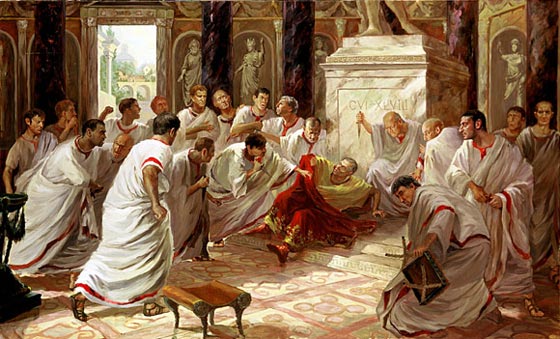
As Caesar arrived to the meeting hall a crowd of senators gathered around him to present him a petition. While Caesar was dealing with the petitioner, one of the senators struck Caesar from behind
Image result for caesar's death
OUTCOME: In his will, Caesar named his 18-year-old great-nephew Gaius Octavian as his heir. At first Antony, Octavian and other close associates of Caesar came together to fight a civil war against the forces loyal to Cassius, Brutus and other Liberators.

Once those forces were defeated, fighting continued between the former members of the alliance in a series of encounters. Octavian finally defeated Antony, opening up the way for him to become the sole ruler. The assassination of Julius Caesar had exactly the opposite to what had been intended by the assassins.
CAPTAIN KIDD: PIRATE OR PRIVATEER?

LOCATION: The Indian Ocean

PERPETRATORS: Captain William Kidd and his crew

MOTIVATION: Robbery, murder, Hijacking

BACKGROUND: The notoriety of Captain William Kidd, who was hanged in London on May 23, 1701, for piracy and murder, arose as much from the publicity surrounding the possibility of a royal and political scandal as it did from the nature of the crimes for which he was convicted.
Little is known of Kidd's early life, beyond the fact that he was born in the Scottish city ov Dundee. The first reliable records concerning him date to 1689, at which time we was about 35 years old and the captain of a ship arriving at the Caribbean island of Nevis, a British colony. He had been sent there on commission by the island's governor to provide protection against possible French attack.
Kidd led raids on islands held by the French in the Caribbean and captured French ships as prizes before moving further north to operate against the French along the coast of New England, sailing out of ports in the English colonies of New York and Massachusetts.
By the 1690's, some pirates from the Caribbean and western Alan tick had begun to look further afield, sailing round the Cape of Good Hope at the tip of the African continent and into the Indian Ocean in order to arrack merchant shipping that was carrying precious cargos from the Far East, leading to the company lobbying the English parliament to take action against the pirates.
The investment allowed Kidd to purchase a brand new ship, the Adventure Galley. In September 1696, alongside a French ship captured previously, he embarked on the voyage to the Indian Ocean.
Over the course of the following year, he had failed to find any pirates and therefore had not taken any prizes, leading to discontent among the remaining crew and raising the threat of mutiny.
It was about this time that rumors began to reach London and New York the Kidd had abandoned privateering for piracy.
Kidd was hoping to negotiate a deal with Lord Bellemont, one of his backers who was also the governor of the English colonies on New York and Massachusetts. When Kidd traveled to see Bellemont, who was in Boston, he was arrested and thrown into jail, where he would remain for over a year before being extradited back to England.
In March 1701, Kidd appeared before the members of parliament in the House of Commons. It remains the only occasion in which a man accused of piracy has been summoned in this manner.
On May 23, 1701, Kidd was hanged at Execution Dock on the bank of the River Thames.


OUTCOME: Kidd was hanged and gibbeted.
THE MAN WHO SOLD THE EIFFEL TOWER (1925)

LOCATION: Paris

PERPETRATOR: Robert Miller, aka Count Victor Lusting

MOTIVATION: Fraud

BACKGROUND: In May 1925, an article appeared in a French newspaper on the declining state of the Eiffel Tower. The iconic landmark had been in public ownership since 1909 and had been neglected for years by the Ministry of Post and Telegraph, so that it had become and an embarrassment to the city of Paris.
Image result for victor lustigLusting was in New York when he read the article about the Eiffel Tower. He traveled to Paris and took a suite luxurious Hotel de Crillon on the Place de la Concorde in the center of the city, near many of the ministries of the French Government. The next step was to send letter out on the headed paper to invite six of the largest scrap metal merchants in Paris to meeting in his suit. Once the merchants were assembled, he told them that the government had decided that it was too expensive to refurbish the Eiffel Tower and intended to sell it off to the highest bidder for scrap.
Lusting had picked his mark, a man called Andre Poisson, who took the bait, perhaps thinking that the payment of backhanders was a necessary expense in order to secure governments contracts.
Lusting cashed the check immediately and left Paris for Vienna with a suitcase full of money.
Lusting waited in Vienna spectating to hear that Poisson had reported him to the police.
Lusting went back to America, where he continued his criminal career for another ten years, branching out into counterfeiting before being arrested by the FBI in 1935.


OUTCOME: The Eiffel Tower is still standing.
THE BOSTON STRANGLER (1962-1964) 

LOCATION: Boston


PERPETRATOR: Albert DeSalvo 


Image result for albert desalvoBACKGROUND: At some point in late February or early March 1965, Albert DeSalvo told George Nassar that he was the Boston Strangler, the man who had terrorized the city for 18 months between June 1962 and January 1964 by murdering 13 single women in their apartments. Both were inmates of Bridgewater State Hospital at the time, a secure mental institution in Massachusetts, Nassar as a convicted murderer and DeSalvo having been sent there for psychiatric assessment following his arrest for a sexual assault. Nassar contacted his attorney, F. Lee Bailey, who interviewed DeSalvo and then took his case when he made a confession to the police in which he provided them with details of the murders. Not everybody was convinced by DeSalvo's confession. Some people suspected that he had conspired with Nassar so that Nassar could claim the reward. Many of his rape victims had positively identified him, leading to the apparent decision by prosecutors that he was certain to be convicted on those charges. To avoid prosecution for 13 murders that he had confessed to having committed still appears to have been an extraordinary decision. After being arrested in October 1964, his picture was published in newspaper to identify him has the man who had raped the women, however, the connection to the Boston strangler was made after DeSalvo's confession. DeSalvo was found guilty, sentenced to life imprisonment, at which time he returned to Bridgewater Hospital. In February 1967, DeSalvo escaped from Bridgewater, leaving a note to say that he had done so as a protest against the conditions there. He surrendered to his attorney the following day and was then sent to a maxim security prison near Walpole, Massachusetts, where remained until he was stabbed to death during the night of November 27 1973, by an unknown assailant. In 2013, semen that had been found on a blanket at the scene of the murder of Mary Sullivan was DNA tested and, when compared to a DNA sample from a living relative from DeSalvo, was found to be a close match, proving beyond reasonable doubt that he could be placed at the scene of the murder. 


OUTCOME: Thanks to modern technologies the identity of the killer was confirmed.